
RAG for Contractors: Why Freshness, Guardrails, and Citations Matter
A safe website chatbot for trades businesses is not a generic model trained on a site. It is a domain-locked retrieval system that answers from current business evidence and knows when not to answer.
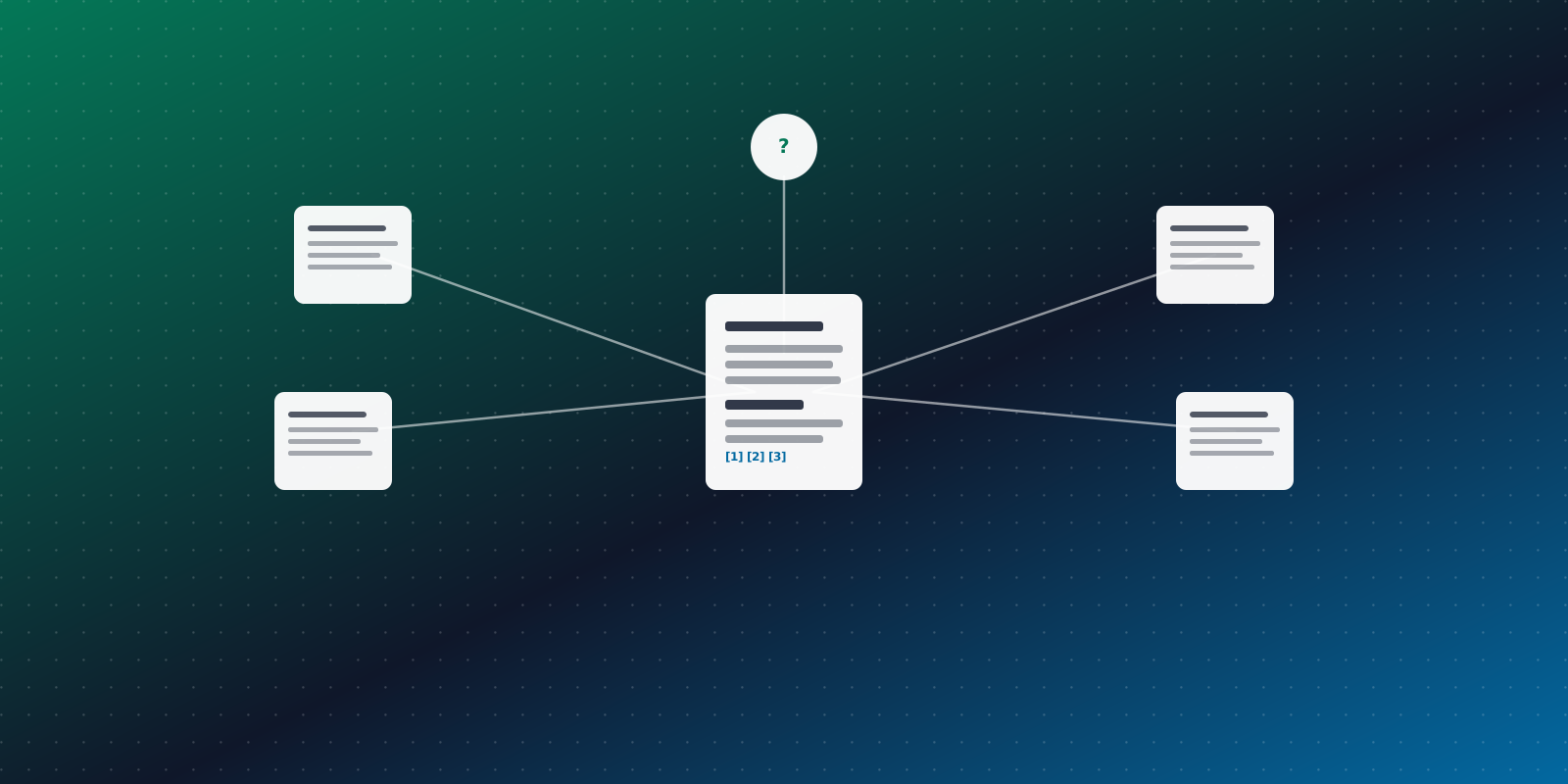
A generic website chatbot can sound confident while being wrong about the exact thing a contractor cannot afford to get wrong: current business truth.
For trades businesses, the risky facts are operational and time-sensitive. Service areas change. Hours change. Emergency coverage changes. Promotions expire. Financing terms update. Dispatch policies vary by location. A model that sounds helpful but guesses on those facts is not a product advantage. It is a liability with a friendly voice.
The practical takeaway
Pulse should not be framed as a chatbot trained on your business. It should be a retrieval system that only answers from your current business evidence.
The Bottom Line
The safe architecture is not loose training in the consumer sense. It is a production retrieval system that continuously ingests the business's current website, PDFs, FAQs, and approved internal notes; tags that content with metadata like tenant, location, effective dates, and document status; retrieves only relevant evidence at runtime; reranks it; and generates an answer grounded in those retrieved sources.
That is the difference between a demo and an operating system. The chatbot should be domain-locked, tenant-isolated, freshness-aware, citation-backed, and explicitly allowed to say it does not know when the business has not published the answer.
"On a trades website, correctness comes from source selection, freshness, and guardrails more than from model eloquence."
The practical split is simple: use RAG for changing textual knowledge, structured tools for live operational facts, and fine-tuning only for behavior, tone, extraction, or tool-use reliability after evals prove it is worth the extra complexity.
The Core Architecture
A good website-copilot architecture has seven stages: source discovery, ingestion, normalization, chunking, retrieval, reranking, and constrained generation. The knowledge base stays outside the model. Retrieval becomes a first-class system. Evaluation decides when extra complexity is justified.
The ingest layer should crawl the canonical site, sitemap pages, landing pages, service pages, FAQ sections, policy pages, financing pages, and downloadable PDFs. It should also support approved non-web sources such as office policy notes, dispatch scripts, or exported documents.
Chunking should be structure-aware, not just character-count based. On a trades site, that usually means heading-bounded chunks for service pages, question-answer chunks for FAQs, and paragraph-or-table-row chunks for pricing or policy documents, with parent-document context restored when the answer is synthesized.
Retrieval should be hybrid by default. Dense semantic retrieval catches paraphrase. Keyword retrieval catches exact-match intent like ZIP codes, discount codes, model numbers, brand names, service names, and policy terminology. Contractor visitors mix both modes constantly.
Reranking should sit between first-stage retrieval and generation. Retrieve a larger candidate set, rerank it, then pass the best evidence to the model. That keeps the answer grounded without dumping the whole website into context.
Generation rule
Hours, pricing, service areas, discounts, warranties, policy terms, and emergency procedures should only be stated when present in retrieved business sources.
How to Model Business Knowledge
Different source types need different handling. Website HTML should be stripped of chrome, navigation, cookie text, and duplicate footer content. Service pages should preserve headings. FAQ pages should preserve question-answer pairing. Policy pages should preserve section boundaries and effective-date language.
PDF handling matters more than people expect. Financing sheets, warranty PDFs, permit checklists, seasonal price books, and safety instructions often contain the actual business truth. Those documents should be parsed into a layout-aware representation so tables, lists, and headings survive ingestion.
Each source should become a versioned document object with chunk-level metadata. At minimum, that metadata should include tenant, source type, canonical URL or file ID, document title, service category, document status, source revision, published date, effective date, expiration date, crawl time, host domain, geography, and whether the content is emergency-approved.
For local contractors, local-search metadata is not just SEO exhaust. Service areas, business hours, location pages, and structured business details are operational truth. They should be normalized into the same evidence system rather than left as disconnected frontend decorations.
- Public content: service pages, FAQs, location pages, pricing pages, warranties, and published emergency policy.
- Customer-visible private content: approved office notes, dispatch scripts, and policy clarifications safe to quote to prospects.
- Internal-only content: escalation instructions, employee phone trees, sales notes, and other material the public chatbot should never retrieve.
Freshness, Versioning, and Tenant Isolation
Freshness is a correctness property. Hours, promotions, service areas, and emergency coverage may change quickly. Evergreen pages may change slowly. A crawler should support hot, warm, and cold freshness classes instead of one universal recrawl interval.
Versioning should be immutable. Every crawl or upload should create a new source revision, every chunk should point back to that revision, and the live index should switch through an active-version pointer rather than in-place mutation. That makes rollback possible when a crawl goes bad, a PDF parser misreads a table, or draft pricing accidentally publishes.
Tenant isolation must be hard, not advisory. A multi-business chatbot should use one namespace, shard, or equivalent hard partition per business, with every write and query scoped to that business. If Pulse is embedded on a contractor's domain, the request should already carry the resolved tenant and allowed hostnames before retrieval begins.
Domain-locked deployment is the application-layer companion to tenant isolation. The widget should be host-bound, the backend should map host to tenant, and the retriever should refuse to search outside that tenant unless an explicitly allowed cross-tenant corpus exists.
Failure Modes and Guardrails
The biggest failure mode is not a weird answer about trivia. It is a plausible business fact the company never authorized: stale hours, wrong service area, unsupported capability claim, hallucinated discount, invented financing offer, or improvised emergency advice.
Stale hours and service-area errors are freshness and filtering bugs, not model-style bugs. The fix is to tag documents with effective dates and geography, retrieve with date and region filters, and bias toward current sources. A bot should not say yes to a ZIP code unless it retrieved tenant-scoped geography evidence.
Unsupported claims happen when the model is rewarded for helpfulness more than faithfulness. The generator needs hard invariants: do not invent prices, discounts, warranties, license status, availability windows, or financing terms; cite each such claim; and if evidence is absent, say so and offer escalation.
Emergency advice needs its own guardrail tier. A trades chatbot should not improvise safety instructions from general world knowledge. It should quote an approved emergency policy, route to the business's authorized emergency flow, or escalate when the situation appears dangerous or outside the published guidance.
No evidence, no answer
A polished but unsupported answer is worse than a clear no-answer fallback. The product should be rewarded for knowing when not to answer.
How to Evaluate It
Evaluation should be built around contractor website risks, not generic chatbot vibes. Every business should have a golden set of expert-verified questions before launch, and that set should keep growing from production failures.
The dataset should include answerable questions, deliberately unanswerable questions, ambiguous questions, stale-content traps, policy exceptions, multi-page reasoning, and high-risk prompts about emergencies, prices, and service areas.
Retrieval and generation should be scored separately. On retrieval, measure hit rate, recall at k, MRR, context relevance, and citation coverage. On answers, measure faithfulness, relevance, correctness, and guideline adherence.
No-answer behavior needs its own tests. A contractor chatbot that refuses to answer an unsupported pricing or emergency question is doing better than one that fabricates a confident answer. Abstention quality is part of product quality.
After launch, human review loops should stay in the system. Low-confidence and high-risk traces should go into an annotation queue. False positives and false refusals should be reviewed weekly and promoted into the golden set before changing prompts, models, chunking, or retrieval settings.
RAG, Tools, and Fine-Tuning
RAG is the right source-of-truth mechanism for changing business knowledge: service descriptions, hours pages, service-area pages, pricing sheets, financing PDFs, FAQs, warranties, and customer-visible policies.
Fine-tuning is a behavior tool, not a live-knowledge database. It can help with tone, refusal style, citation style, extraction behavior, dispatch-summary formatting, or tool selection. It should not be used to memorize current emergency dispatch fees or service-area rules.
Structured tools should handle live operational state: scheduling availability, dispatch status, customer-specific entitlements, finance pre-qualification, coupon eligibility, and exact ZIP coverage. If the answer must come from an authoritative live system, it should not come from text search.
The best production system uses all three, but for different jobs: RAG for current business knowledge, tools for live state and actions, and optional fine-tuning for consistency once evaluation proves the basic stack is strong.
Sources Used
- OpenAI: retrieval, file search, citations, prompt guidance, function calling, model optimization, and eval-driven development.
- Anthropic: contextual retrieval, reranking, agent guardrails, and evaluation-driven tool design.
- LangChain, LangSmith, and LlamaIndex: retrieval architecture, chunking, evaluation, human review, and knowledge-base design.
- Pinecone, Weaviate, Elastic, Qdrant, Chroma, BEIR, and pgvector: hybrid retrieval, namespaces, multitenancy, reranking, chunking, and filtered vector-search behavior.
- Google Business Profile and LocalBusiness documentation: service areas, hours, local business details, and structured operational facts.
Free audit
Want a chatbot that answers from evidence, not vibes?
We can help turn your service pages, PDFs, policies, service-area rules, and handoff logic into a grounded knowledge system for Pulse.
Design a safe knowledge base
Written by
Colin Lawless
Co-founder, CTO at Laddr
Colin writes about front-desk systems for trades businesses: missed calls, lead response, review cadence, website conversion, and the AI workflows that help small shops stop leaking revenue.